


| Issue |
J. Eur. Opt. Society-Rapid Publ.
Volume 22, Number 2, 2026
PLASMONICA Collection
|
|
|---|---|---|
| Article Number | 59 | |
| Number of page(s) | 4 | |
| DOI | https://doi.org/10.1051/jeos/2026052 | |
| Published online | 28 July 2026 | |
Short Communication
Remembering Professor Alessandro Belardini
Sapienza University of Rome, Department SBAI, Rome, 00161, Italy
* Corresponding author: This email address is being protected from spambots. You need JavaScript enabled to view it.
Received:
25
April
2026
Accepted:
1
July
2026
Abstract
Alessandro Belardini, a great professor, mentor and scientist, prematurely passed away on 9 February 2026, shortly after his 54th birthday. He is deeply missed in both Italian and International community of plasmonics and nanophotonics, for both research and teaching, and for his infinite kindness, patience, and support of the young peers. To his students, he was a Renaissance man, answering questions with dedication and depth, willing to help with empathy. To his research colleagues, his nonlinear and chiro-optical experiments led to pioneering contributions in chiro-optical research at the nanoscale. Moreover, he was dedicated to the mission of the European Optical Society, its Italian branch, and the Plasmonica working group in plasmonics and nano-photonics. Behind more than 100 highly impactful research articles and proceedings, there is his name, efforts and dedication. However, as we were privileged to directly work and learn from him, in this memoriam article we would like to remember him for his personal virtues, and skills he had as a professor, supervisor and mentor.
Key words: In memoriam / Mentorship / Chirality / Nonlinear optics / Plasmonics / Plasmonica
© The Author(s), published by EDP Sciences, 2026
 This is an Open Access article distributed under the terms of the Creative Commons Attribution License (https://creativecommons.org/licenses/by/4.0), which permits unrestricted use, distribution, and reproduction in any medium, provided the original work is properly cited.
1 Introduction
Professor Alessandro Belardini passed away on 9 February 2026, in Rome, Italy, following a sudden and brief serious illness. His loss has deeply affected the scientific community, students, and friends around the world. He was a rare combination of an academic figure that is both an excellent scientist and a patient teacher, supervisor and a team-leader. He was a beloved member of the Plasmonica community, and one of the leading professors of the European Optical Society. In the following, we remember our academic journeys with the Professor from different perspectives: the one of the bachelor thesis student, the one of his PhD student, and the one of his colleague, former postdoc.
2 Much more than a Physics professor: by Nicolò Borriello, former bachelor thesis student
“Ciao belli…”: he greeted everybody like this every time, with a big, almost hugging smile, which I have always found particularly reassuring. From what I was told before starting university, especially regarding relationships with one’s thesis supervisor, I would have never expected anything like this. Beyond exams and research, small gestures of comfort and affection, conveyed with calmness and warmth, indirectly said, “I am here for you”. That is exactly how it was – Professor Belardini was somehow always there, despite all the commitments.
I remember some of the phone calls we had, when exam-related panic would overwhelm me and I did not know how to proceed. Professor Belardini was always ready to listen and to help, never holding back. The first times we met, he told me: “If you should need anything at all, do not hesitate to text to me”. I took those words quite literally: about a week later, an upcoming exam frightened me and he replied to that email saying: “call me, this is my office number, so we can talk it through better”. At this moment, I firmly believe that the first phone call marked the beginning of a journey and a remarkable relationship, during which he introduced me to many of his colleagues, even though I was a bachelor student. Not surprisingly, everyone cared for him, and still cares for him, in an almost unimaginable way.
It was not immediately clear to me, but over time, I understood why. Our journey was long, varied, and full of unforgettable moments. I clearly remember our days in his laboratory of nonlinear and chiral optics: his long explanations about how components worked, and why some creative solutions were needed. I also remember our conversations during long morning hours, during which he would postpone other commitments for the sake of genuine discussions. During these office hours, for the first time, I felt that a university professor saw me not as just any student, but as a person – made of strengths and insecurities, gaps, flaws, and fears. What was different, however, was the absence of fear in showing all of this: in front of Professor Belardini, there was no sense of evaluation or judgment. Instead, what one felt was a sense of equality, in which each could learn something from the other, without being judged. I remember the meetings in his office to discuss the thesis, about new books he had read and wanted to recommend, about articles he would send me promptly, about calls for applications to acquire new lasers his group was planning to purchase. On the other hand, as a group leader, he was able to make his research thrive, because he knew how to make a perfectly balanced working environment full of different students and colleagues. I believe that his skill to coordinate many people while maintaining the calmness is what defined Professor Belardini, besides scientific and teaching achievements, a great leader. Thanks to this leadership, the part of my bachelor thesis work was presented at Plasmonica 2025 Workshop, and published shortly after [1].
Moreover, he never wanted us, as students, to perceive the barriers of academic hierarchy. I remember when we would see him with other professors: he would immediately detach himself, come to greet us, and start talking not only with me, but also with other students he would not necessarily know. He was genuinely interested in the well-being of students, and that the University opens many paths for us, and he fought hard to ensure that the excellence was recognized. More importantly, he taught me that when hard times arrive, one must calmly seek a solution instead of running away and worrying, and he convinced me that no one is alone even when everyone is distant.
3 The importance of a supportive and present PhD supervisor: by Claudia Skubisz, PhD student
I had the privilege of knowing and working with Alessandro Belardini; I remember him not only as a professor, but as a guide, a point of reference, and a rare human presence. Writing about him, for me, means trying to hold together what he was scientifically and what he was, deeply, in my life. It is not an easy task: some people cannot be explained, they must be experienced. There are not enough words to describe what he has been and what he will continue to be. In nanophotonics, we invent new materials for nanoscale interactions, but we do not invent new words.
I still remember my first days of my PhD: I came to Professor Belardini with doubts, uncertainties, questions that seemed to have no answers; I thought I would get lost, and that I would not be good enough. However, Professor Belardini responded with a luminous calm. There was a special light within him, that of someone who not only knows science, but who lives it and transmits it naturally. In that moment, I understood how fortunate I was to have him as a supervisor. For me, it was a new, fragile path; for him, it was a journey he knew how to make solid, possible, and almost simple.
Together we rewrote programs, reorganized ideas, and shaped the functioning of a new experimental set-up. I remember the days spent even sitting on the floor, programming, discussing, putting every detail back in order, and searching for the best solution. It was not just work: it was sharing, it was growth, it was a mutual trust, taking shape day by day. He taught me to believe in myself, offering support when I was uncertain. For example, I remember him suggesting that I apply for the Best Thesis Award and submit my first article [2]: I hesitated, but he had no doubts, and he was right. In the end, more than the result, what remains is the way he saw me: a gaze that anticipated possibilities I was not yet able to imagine.
The importance of having a PhD supervisor who was always supportive and present is perhaps what I will carry with me the most. I never saw him angry or overwhelmed. In moments when everything seemed to become complicated, when deadlines were tight and components were not working, he would always come to the laboratory, with a calmness that was not a distance, but a full presence. He was speaking to us with a clarity that reassured, with his sincere and gentle smile, capable of dissolving even the strongest tensions. In moments of panic, he was the steady point of the PhD journey, restoring the order without the need of many discussions.
He taught me that kindness, irony, and a smile are not marginal to scientific life, but an integral part of it; that one can be rigorous without losing lightness, profound without becoming distant. What made him unique as a supervisor was also a constant presence, in both the beautiful moments and the more difficult ones. I will miss our conversations at the bar, where we talked about everything: research, life, philosophy, and even those small things that could lighten the day. I will miss his sincere and spontaneous support, which never failed to calm me down and convey his seemingly inexhaustible positive energy. I will miss the mornings when I would call him to share an idea that had suddenly come to mind. My ideas sometimes seemed disordered, but he knew how to welcome, listen to, and then patiently transform them into clear paths. Together we always found a meaning, often among improvised sketches and boards full of notes. What remains, beyond his scientific legacy, is the way he knew how to be there. Finally, I know that, every time I find myself in difficulty, I will look for that calm of his, that smile and somehow, I will find him there.
4 High bar for teaching and mentorship: by Emilija Petronijevic, researcher and professor in physics
Professor Belardini was and will continue to be the crucial figure in my research and academic career: from the very start of my PhD journey, to the final, sad times, during which he was still fighting for young researchers, caring about our experiments and students, and envisioning the laboratory future.
I clearly remember the first day of my PhD studies at the University La Sapienza, Rome (Italy), when I got lost in the labyrinth of laboratories at our Department. I was aware of his influential contributions to the field of self-assembled nanostructures and nonlinear chiro-optical experiments [3–6], therefore I was worried that my background would not be enough for the already strong group. Next, I saw this kind and reassuring professor who came to show me the way, smiling and saying “welcome” from the bottom of his heart. For the next 11 years at the same Department, he continued to show me how one should approach research and teaching in physics and optics. More importantly, he treated us, younger researchers, with respect and support through all the ups and downs of the PhD, postdoc and researcher career.
The scientific journey with Professor Belardini was a truly enlightening experience, full of patience, enthusiasm and readiness to help; he taught me new, practical skills that helped me cross the barrier between theoretical and experimental aspects of our research. More importantly, he taught me what is important in studying and self-improvement: that it should be profound and steady instead of being fast and superficial, and that it never stops, which is also the beauty of the research in chiral nanophotonics. Later, I learned from other PhD students and postdocs of my generation, that this calm way of teaching, studying and working is a rather unique privilege – to have a mentor that is never judgmental of one’s previous background. In the first weeks of my PhD in the same group with Professor Belardini, I joined nonlinear optical experiments he was performing [7, 8]. May I say that, before entering that laboratory, I had never seen a femtosecond laser before, while I also immediately touched some sensitive optical components with my fingers! However, as already indicated above, Professor Belardini’s patience, positivity and faith were undestroyable, so he confidently continued to help and teach me until the mistakes became rarer. When comparing the experimental and simulated data, he taught me which I should trust more; he was always warning me to be more patient, and even slower in drawing conclusions. I remember one specific situation in which I saw the greatness of his mentorship: after some months with a new experimental set-up, I finally introduced changes without his permission, and invited him to come and correct it. On that day, he was more proud of his mentorship than when an article would get accepted: he was profoundly dedicated to teaching and knowledge transfer. Therefore, seeing his student becoming more independent was a great success. In the last years, in his laboratory, we decided to take unconventional path in nanophotonics: to enrich the chiro-optical set-up with photo-acoustic cells. This opened new degrees of freedom in photo-acoustic spectroscopy with a laser; nowadays, we use it with a microscope, to sensitively measure absorption and chirality in nanomaterials [9].
His dedication to spreading the knowledge to students of all levels has strongly influenced generations of engineers and young researchers. I had a privilege to teach a Physics 1 course with him, and to co-supervise his students. I admired his dedication in student-professor interactions, answering questions, repeating explanations and often prolonging the working hours, as if it was not a job for him, but a joy.
Another important aspect of his mentorship was the openness to the broader community. He would say that one must also go out of the laboratory, into the world, and that the collaboration between early stage researchers and with other groups is crucial for the future of the laboratory. He strongly believed in the European Optical Society mission and its Italian branch, the Italian Society for Optics and Photonics (SIOF); he worked hard as a member of the Presidential Council, as a secretary, and he was finally elected as the next President of SIOF. Moreover, he introduced many of students of our department to Plasmonica, the Plasmonics and Nano-Optics working group within SIOF. Below we show the photo from the last workshop in Modena in 2025, portraying him as the group leader, with us, different generations of students. Every year, after the Plasmonica workshop, he would return to the laboratory, full of the ideas for the next experimental works and eager to start new collaborations. Indeed, the summer of 2025 was very busy in our laboratory, resulting in two publications [1, 10].
Finally, the classrooms of the University la Sapienza and the laboratories of the SBAI Department will never be the same without his kindness, knowledge and patience. Yet, his presence is felt through what he taught us: from the first problems of classical mechanics and thermodynamics, to the latest discoveries of chiro-optical effects at the nanoscale [11]. More importantly, he showed us how one can become brilliant, critically minded scientist, while remaining a kind, patient and lovely person who treats all of his students and peers equally and with respect.
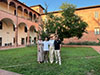 |
Figure 1 Photo taken at Plasmonica 2025 Workshop in Modena: Professor Alessandro Belardini with his students Emilija, Nicolò and Claudia. |
Funding
This research received no external funding.
Conflicts of interest
The authors have nothing to disclose.
Data availability statement
Data obtained in this work are not publicly available at this time but may be obtained from the authors upon reasonable request.
Author contribution statement
Conceptualization, N.B., E.P. and C.S.; Methodology, E.P.; Writing – Original Draft Preparation, C.S., N.B. and E.P.; Writing – Review & Editing, all authors; Supervision, E.P.
References
- Borriello N, Petronijevic E, Schlachet-Lépinay J, Skubisz C, Leahu G, Hakkarainen T, Sibilia C, Li Voti R, Belardini A, Tunable modulation frequency in photo-acoustic spectroscopy towards precise discrimination of resonant modes in nanostructures on absorbing substrates, J. Eur. Opt. Society-Rapid Publ. 22, 37 (2026). https://doi.org/10.1051/jeos/2026020. [Google Scholar]
- Skubisz C, Petronijevic E, Leahu G, Cesca T, Scian C, Mattei G, Sibilia C, Belardini A, Photo-acoustic technique with widely tuneable laser: metasurface circular dichroism response, J. Eur. Opt. Society-Rapid Publ. 20, 1 (2024). https://doi.org/10.1051/jeos/2024016. [Google Scholar]
- Belardini A, Larciprete M. C, Centini M, Fazio E, Sibilia C, Chiappe D, Martella C, Toma A, Giordano M, Buatier de Mongeot F, Circular dichroism in the optical second-harmonic emission of curved gold metal nanowires, Phys. Rev. Lett.. 107, 257401 (2011). https://doi.org/10.1103/PhysRevLett.107.257401. [NASA ADS] [CrossRef] [Google Scholar]
- Belardini A, Pannone F, Leahu G, Larciprete MC, Centini M, Sibilia C, Martella C, Giordano M, Chiappe D, Buatier de Mongeot F, Asymmetric transmission and anomalous refraction in metal nanowires metasurface, J. Eur. Opt. Society-Rapid Publ. 7, 12051 (2012). https://doi.org/10.2971/jeos.2012.12051. [Google Scholar]
- Belardini A, Centini M, Leahu G, Fazio E, Sibilia C, Haus J. W. Sarangan A, Second harmonic generation on self-assembled tilted gold nanowires, Faraday Discuss., 178, 357–362 (2015). https://doi.org/10.1039/C4FD.00200H. [Google Scholar]
- Belardini A, Benedetti A, Centini M, Leahu G, Mura F, Sennato S, Sibilia C, Robbiano V, Martella C, Comoretto D, Second harmonic generation circular dichroism from self-ordered hybrid plasmonic-photonic nanosurfaces, Adv. Opt. Mater. 2, 208–213 (2014). https://doi.org/10.1002/adom.201300385. [Google Scholar]
- Petronijevic E, Tomczyk M, Belardini A, Osewski P, Piotrowski P, Centini M, Leahu G, Li Voti R, Pawlak DA. Sibilia C, Larciprete MC, Surprising eutectics: enhanced properties of ZnO-ZnWO4 from visible to MIR, Adv. Mater. 35, 2206005 (2023). https://doi.org/10.1002/adma.202206005. [NASA ADS] [CrossRef] [Google Scholar]
- Osewski P, Belardini A, Petronijevic E, Centini M, Leahu G, Diduszko R, Pawlak DA, Sibilia C, Self-phase-matched second-harmonic and white-light generation in a biaxial zinc tungstate single crystal, Sci. Rep.. 7, 45247 (2017). https://doi.org/10.1038/srep45247. [NASA ADS] [CrossRef] [Google Scholar]
- Petronijevic E, Leahu G, Skubisz C, Li Voti R, Sibilia C, Belardini A, Listening to nanostructures' absorption with many degrees of freedom: widely tunable photo-acoustic characterization, Eur. Phys. J. Plus. 140, 613 (2025). https://doi.org/10.1140/epjp/s13360-025-06578-5. [Google Scholar]
- Petronijevic E, Ali H, Freddi S, Anzi L, Sordan R, Bollani M, Andreani LC, Belardini A, Photo-acoustic spectroscopy detects nanostructures against resonant and absorbing substrates, J. Eur. Opt. Society-Rapid Publ. 21, 49 (2025). https://doi.org/10.1051/jeos/2025048. [Google Scholar]
- Petronijevic E, Belardini A, Leahu G, Li Voti R, Sibilia C, Nanostructured materials for circular dichroism and chirality at the nanoscale: towards unconventional characterization [Invited], Opt. Mater. Express 12(7), 2426–2937 (2022). https://doi.org/10.1364/OME.456496. [Google Scholar]
All Figures
|
Figure 1 Photo taken at Plasmonica 2025 Workshop in Modena: Professor Alessandro Belardini with his students Emilija, Nicolò and Claudia. |
| In the text | |
Current usage metrics show cumulative count of Article Views (full-text article views including HTML views, PDF and ePub downloads, according to the available data) and Abstracts Views on Vision4Press platform.
Data correspond to usage on the plateform after 2015. The current usage metrics is available 48-96 hours after online publication and is updated daily on week days.
Initial download of the metrics may take a while.