


Figure 1
Download original image
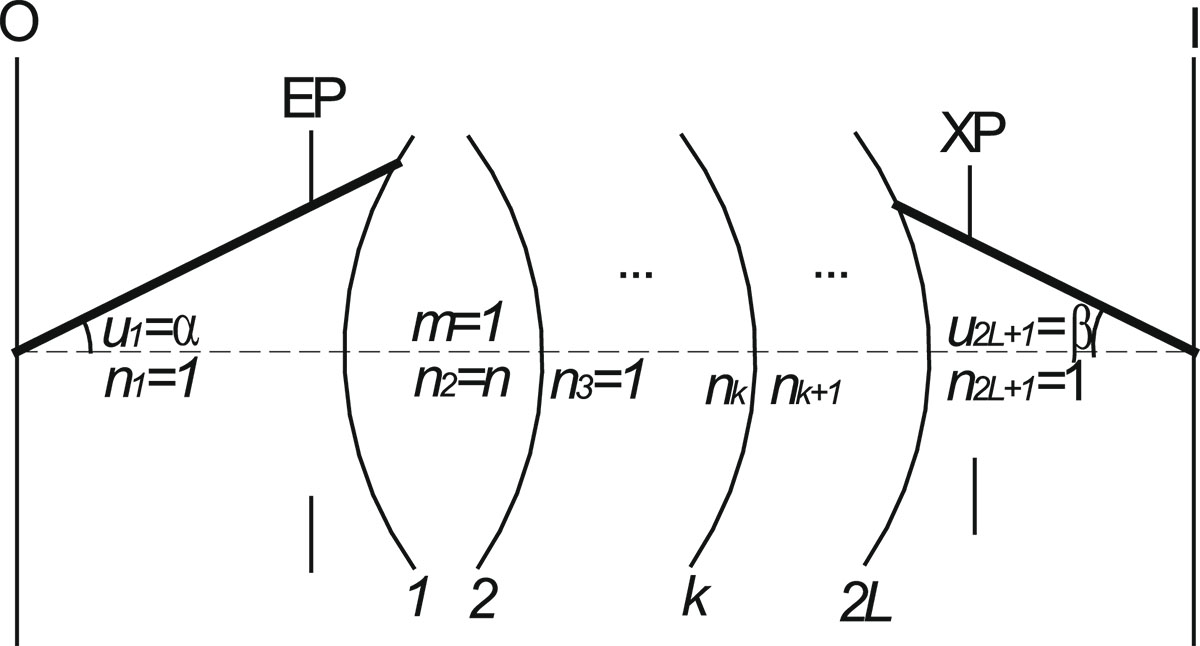
The paraxially traced marginal ray (thick line) has before the first surface of the group of L lenses the angle  with the optical axis and after the last surface the angle
  . The refractive index before surface k is
  , after the surface it is
  .The surface numbering for the marginal ray angles
  is the same. Inside each lens (i.e. for even k values) the refractive index is n, as shown here for the first lens (m=1) with surfaces 1 and 2. Outside the lenses we have
  . In this figure, the L lenses of interest form the entire optical system, but the same notation is used when these lenses are part of a larger system. The planes of the object, image, entrance pupil and exit pupil are denoted by O, I, EP and XP respectively. In the thin-lens approximation, all axial distances between surfaces 1 and 2L will be set equal to zero in the aberration formulas.
Current usage metrics show cumulative count of Article Views (full-text article views including HTML views, PDF and ePub downloads, according to the available data) and Abstracts Views on Vision4Press platform.
Data correspond to usage on the plateform after 2015. The current usage metrics is available 48-96 hours after online publication and is updated daily on week days.
Initial download of the metrics may take a while.