


| Issue |
J. Eur. Opt. Society-Rapid Publ.
Volume 22, Number 1, 2026
|
|
|---|---|---|
| Article Number | 12 | |
| Number of page(s) | 12 | |
| DOI | https://doi.org/10.1051/jeos/2025053 | |
| Published online | 24 February 2026 | |
Supplementary Material
Supplementary material 1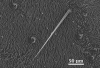 |
Figure S1.
Top view of the cuticle of Calliphora vicina’s abdomen using SEM. In addition to long hairs (known as macrotrichia) observed by optical microscopy, shorter hairs (also called microtrichia) of about 20 μm can be observed. |
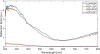 |
Figure S2.
CP reflectance spectrophotometry was used in order to highlight possible light-polarising effects arising from the pattern observed within Calliphora vicina’s cuticle that might be associated with a Bouligand structure. Despite the electron micrograph observations, only cross-CP components have significant intensities. Co-CP reflectance spectra that usually contains the signature of Bouligand structures display negligible intensities. |
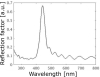 |
Figure S3.
Reflectance spectra of a pseudo-periodic multilayer derived from Calliphora vicina photonic model (Fig. 7) with random thickness deviations of ± 15 nm in the high-contrast layers and ± 5 nm in the low-contrast layers. The resulting calculated spectra were averaged over incidence angles from −5° to +5°. A broader reflectance peak than the ideal model (Fig. 8a) is observed, though still narrower than the measured spectrum (Fig. 3a). |
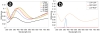 |
Figure S4.
For comparison, CP reflectance was modelled for a Bouligand structure (18 half-pitches of 118 nm, an average refractive index of 1.56 [79], in-plane birefringence of 0.018 [66]) covered by a 180 nm-thick isotropic film (n = 1.75), calculated for incidence and emergence angles ranging from 0° to 75° in 15° increments in cross-CP configuration (a) and at normal incidence in co- and cross-CP configuration (b). Modelled CP reflectance spectra in (a) appear as broad as the experimental spectra measure from Calliphora vicina (Fig. 3a). The left-left co-CP (LCP-LCP) spectrum exhibits a small peak in the UV range. In the real photonic structure of C. vicina, positional disorder [44], light absorption, and scattering would likely reduce this co-CP signal to a very weak level. |
© The Author(s), published by EDP Sciences, 2026
Current usage metrics show cumulative count of Article Views (full-text article views including HTML views, PDF and ePub downloads, according to the available data) and Abstracts Views on Vision4Press platform.
Data correspond to usage on the plateform after 2015. The current usage metrics is available 48-96 hours after online publication and is updated daily on week days.
Initial download of the metrics may take a while.